

History
A short history of baklava.
Who invented it? Many countries claim it. What is certain: baklava was perfected in the kitchens of the Ottoman Empire – and in Gaziantep it became an art.
Origins
Many roots, one idea
Paper-thin layers of dough, nuts and syrup: the idea is old, and many cuisines between Central Asia, Anatolia, Persia and the Mediterranean know similar pastries. A common theory traces baklava back to the Turkic peoples of Central Asia, who stacked thin sheets of dough – yufka. Others see its ancestors in Byzantine or Persian sweets.
There is no single answer. Perhaps that is the beauty of it: baklava belongs to many – but every region makes it its own way.
Ottoman Empire
From the palace kitchen
Baklava was refined in Istanbul’s Topkapı Palace. The palace bakers stretched the dough ever thinner; records of the palace kitchen from the 15th century are considered early evidence of baklava.
This gave rise to a famous custom, the baklava procession or “Baklava Alayı”: in the middle of Ramadan the sultan had trays of baklava presented to the Janissaries, his soldiers. They were carried in a ceremonial procession from the palace to the barracks.
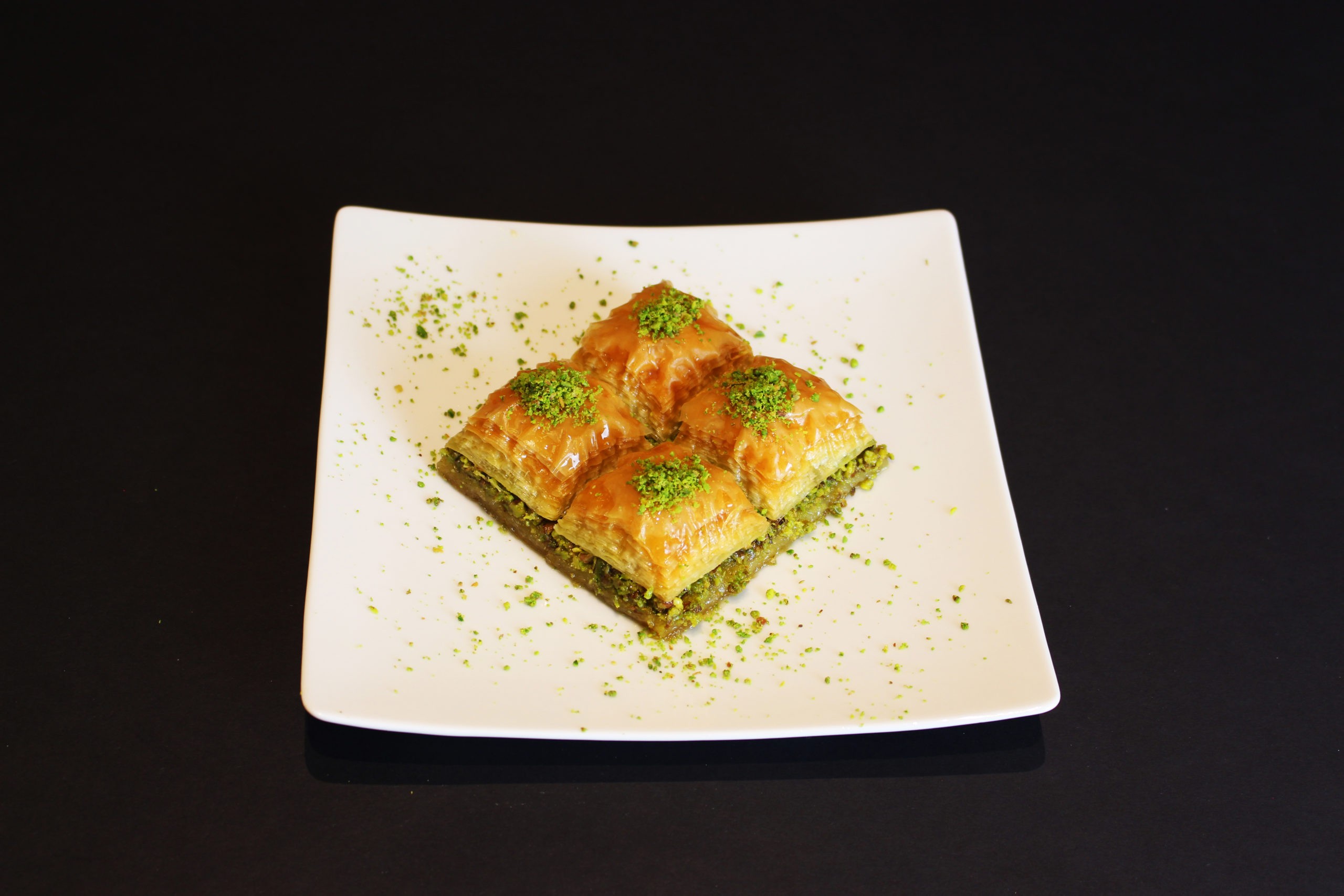
Classic pistachio baklava – made by hand, layer by layer.
Gaziantep
How one city became the capital of baklava
What makes Gaziantep special is the combination of ingredient and craft: the pistachios grow on the doorstep, and the art of baking baklava has been passed from master to apprentice for generations. To this day, baklava from Gaziantep is the benchmark all over Türkiye. More about Gaziantep
To Europe
From Istanbul to Kottbusser Damm
With the Ottoman Empire, baklava spread across the Balkans to Greece and the Levant. Every region now has its own version – sometimes with walnuts, sometimes with honey, cinnamon or rosewater.
It came to Germany above all with the people who moved here from Türkiye from the 1960s onwards. Berlin has one of the largest Turkish communities outside Türkiye – and baklava has long been part of the city. Since 2009 we have been baking it here too, to our family’s recipe from Gaziantep.
Quality
How to recognise good baklava
It crackles.
When you cut it, you hear the layers break – a soft crackle is the first sign of fresh, good baklava.
The layers are paper-thin.
The thinner the dough, the finer and lighter the baklava.
The base is crisp.
It should never be soggy at the bottom. The syrup should soak the layers, not drown them.
It shines without being sticky.
Good baklava is sweet, but not heavy or sticky.
The pistachio is green.
A strong green shows fresh, early-harvested pistachios.
Optional: quote from the master on quality
Enjoying it
How to eat baklava
Best at room temperature, with your fingers, one piece at a time. A strong Turkish tea or a Turkish coffee balances the sweetness with its bitterness. In Türkiye baklava is also often eaten with a scoop of ice cream or with kaymak, a thick clotted cream.